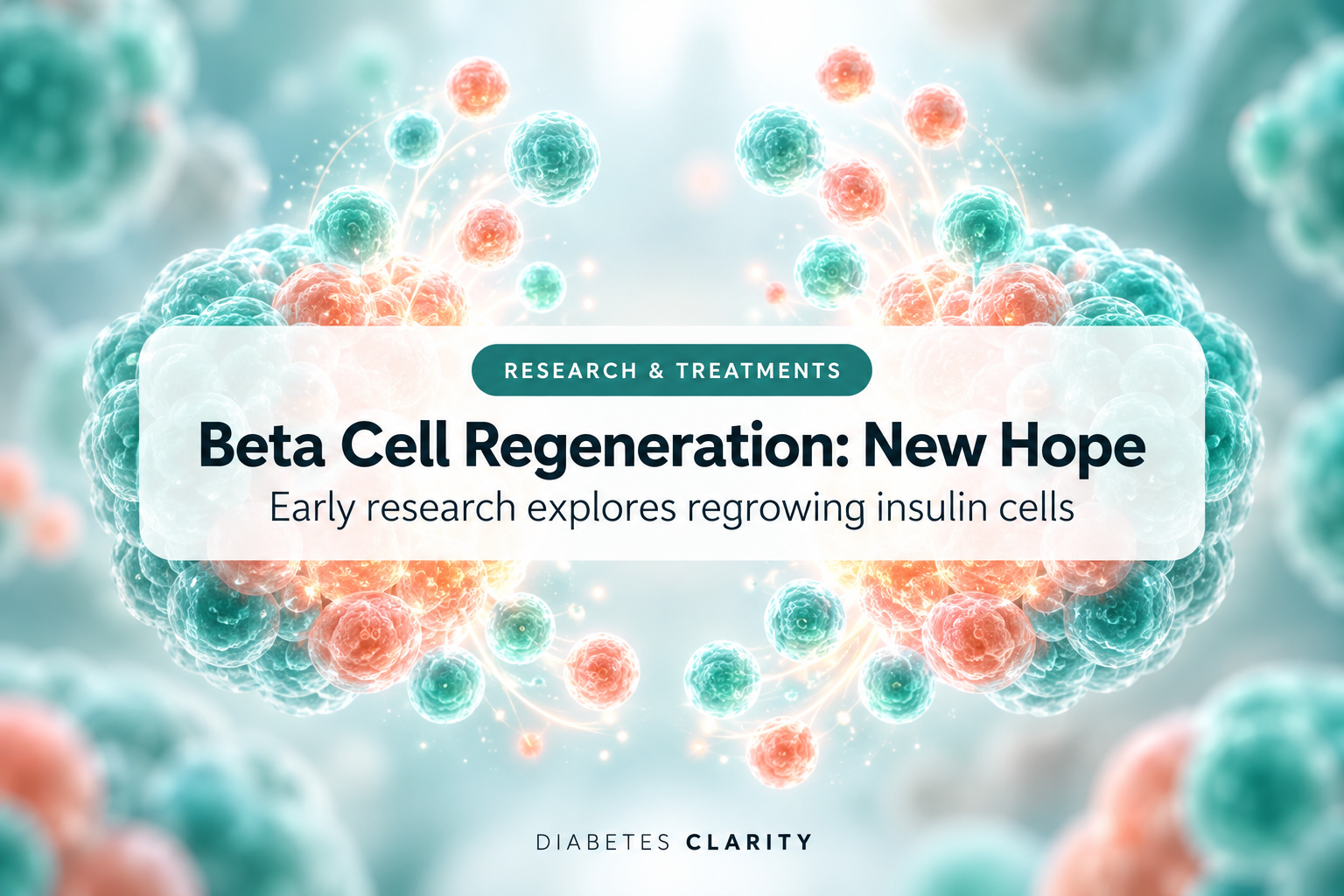
Beta Cell Regeneration: What’s New in October 2026
Scientists around the world are working on a question that matters enormously to people with diabetes: can we regrow the body’s own insulin-making cells? In October 2026, several research teams published promising early findings — but it’s important to understand what’s real progress and what’s still years away from your GP’s clinic.
Beta cells are the cells inside your pancreas that make insulin, the hormone that helps move glucose (sugar) from your blood into your cells for energy. In type 1 diabetes, the immune system destroys these cells. In type 2 diabetes, beta cells can become exhausted or reduced in number over time. Regrowing or replacing them is one of the “holy grails” of diabetes research.
The short version
- Several research groups reported new ways to turn other pancreas cells into insulin-making beta cells, or to help existing beta cells survive and multiply.
- This research is almost entirely in laboratory dishes and mice, with early human trials only just beginning for some approaches.
- The most advanced human studies involve replacing beta cells using lab-grown stem cells, not yet regenerating a person’s own cells.
- None of this is an approved treatment in Australia right now — but it’s a genuinely active and hopeful area of science.
What’s new this month
Researchers at the Joslin Diabetes Center in the United States identified a gene called ALDH3B2 that helps keep pancreatic duct cells “acting like” duct cells rather than beta cells. When they switched this gene off in human duct cells grown in the lab, some of the cells started behaving like beta cells — making insulin and responding to glucose. The same effect was seen in diabetic mice. Importantly, only some cells converted, and they weren’t fully mature beta cells, so this is an early proof-of-concept rather than a finished therapy.
Meanwhile, biotech companies Caspian Therapeutics and Kura Oncology reported laboratory results for a drug called KO-7246, which blocks a protein called menin. Menin normally acts as a “brake” on beta cell growth. Removing that brake expanded insulin-producing cells and improved blood glucose in mouse models, and also encouraged growth in human islet tissue in the lab. The companies are now planning clinical studies to see if this works safely in people.
A separate US biotech, Syntax Bio, announced it could guide stem cells toward becoming beta-like cells in just four days using a gene-editing tool, a step that could eventually speed up manufacturing of replacement cells. Researchers at Weill Cornell Medicine also found that blocking certain stress signals inside beta cells (pathways called JNK and p53) helped protect existing beta cells from dying in mice and donated human islets — a “protection” strategy rather than regrowing new cells. In Israel, Tel Aviv University researchers showed that tiny blood vessel cells called pericytes release a growth factor that helps keep nearby beta cells healthy and functioning, adding to our understanding of what beta cells need to thrive.
What the evidence actually shows
It’s worth being clear-eyed here. All of these October 2026 findings come from laboratory experiments and mouse studies, or very early-stage planning for human trials. A newly funded European project called BetaProtect, for example, received a grant this month specifically to prepare the groundwork for a future first-in-human trial of a beta-cell regeneration therapy for type 2 diabetes — but that trial hasn’t started yet.
The most clinically advanced area remains beta-cell replacement rather than regeneration. Stem-cell-derived islet therapies, such as the one being developed by Vertex Pharmaceuticals, have shown that some trial participants with type 1 diabetes achieved insulin independence after receiving lab-grown insulin-producing cells. This is exciting, but these therapies still generally require immune-suppressing medication to stop the body rejecting the new cells, and long-term safety and durability are still being studied.
Who this affects
- Type 1 diabetes: Most advanced research focuses on replacing destroyed beta cells with new ones, often requiring protection from the immune system.
- Type 2 diabetes: Research like the Baker Heart and Diabetes Institute’s work on reprogramming pancreatic duct cells (using human islet organoids, lab-grown mini-models of the pancreas) is exploring regeneration of a person’s own cells.
- Prediabetes and gestational diabetes: This research doesn’t yet have direct relevance, though understanding beta-cell health broadly may help future prevention strategies.
Availability in Australia
None of these approaches are approved or available as treatments through the TGA (Therapeutic Goods Administration) or listed on the PBS (Pharmaceutical Benefits Scheme) in Australia. Donor islet transplantation remains available in Australia for a small number of people with severe, hard-to-manage type 1 diabetes, but it requires lifelong immune-suppressing medication and depends on donor organ supply.
What we still don’t know
Big questions remain unanswered: Will lab-made beta cells keep working for years, or fade over time? Can regeneration happen without lifelong immunosuppression? How will these therapies be made affordable and scalable? And critically, in type 1 diabetes, how do you stop the immune system attacking new cells the same way it attacked the originals?
What this means for you
- This is genuinely hopeful, forward-looking research — but it is not a reason to change anything about your current diabetes management today.
- If you’re interested in future clinical trials, ask your endocrinologist or diabetes educator whether any registries (such as those run through Breakthrough T1D) might suit you.
- Keep questions for your healthcare team focused on what’s relevant now: your current glucose targets, HbA1c, and any new PBS-listed medicines that are actually available.
- Be wary of anyone online claiming a “beta cell regeneration cure” is available now — genuine researchers are careful to describe this as early-stage work.
Where to next
Beta-cell regeneration research reminds us how much global scientific effort is going into improving — and one day transforming — life with diabetes. While we wait for these discoveries to mature, explore more of our practical guides on Diabetes Clarity, including daily meal ideas, recipes, and tips for everyday blood glucose management.
📖 Sources:
• Joslin Diabetes Center – ALDH3B2 gene and duct-cell reprogramming research – October 2026
• Caspian Therapeutics & Kura Oncology – KO-7246 menin inhibitor preclinical results – October 2026
• Cornell University (Weill Cornell Medicine) – JNK/p53 stress pathway and beta-cell protection – October 2026
• Tel Aviv University – islet pericytes and beta-cell function research – October 2026
• CORDIS (European Commission) – BetaProtect project grant for type 2 diabetes beta-cell regeneration – October 2026
• Baker Heart and Diabetes Institute – EZH-mediated human islet organoid regeneration project – 2026
• BioSpace / Syntax Bio – stem-cell-to-beta-cell differentiation platform – October 2026