Smart Insulin News: What’s Real vs What’s Still Research
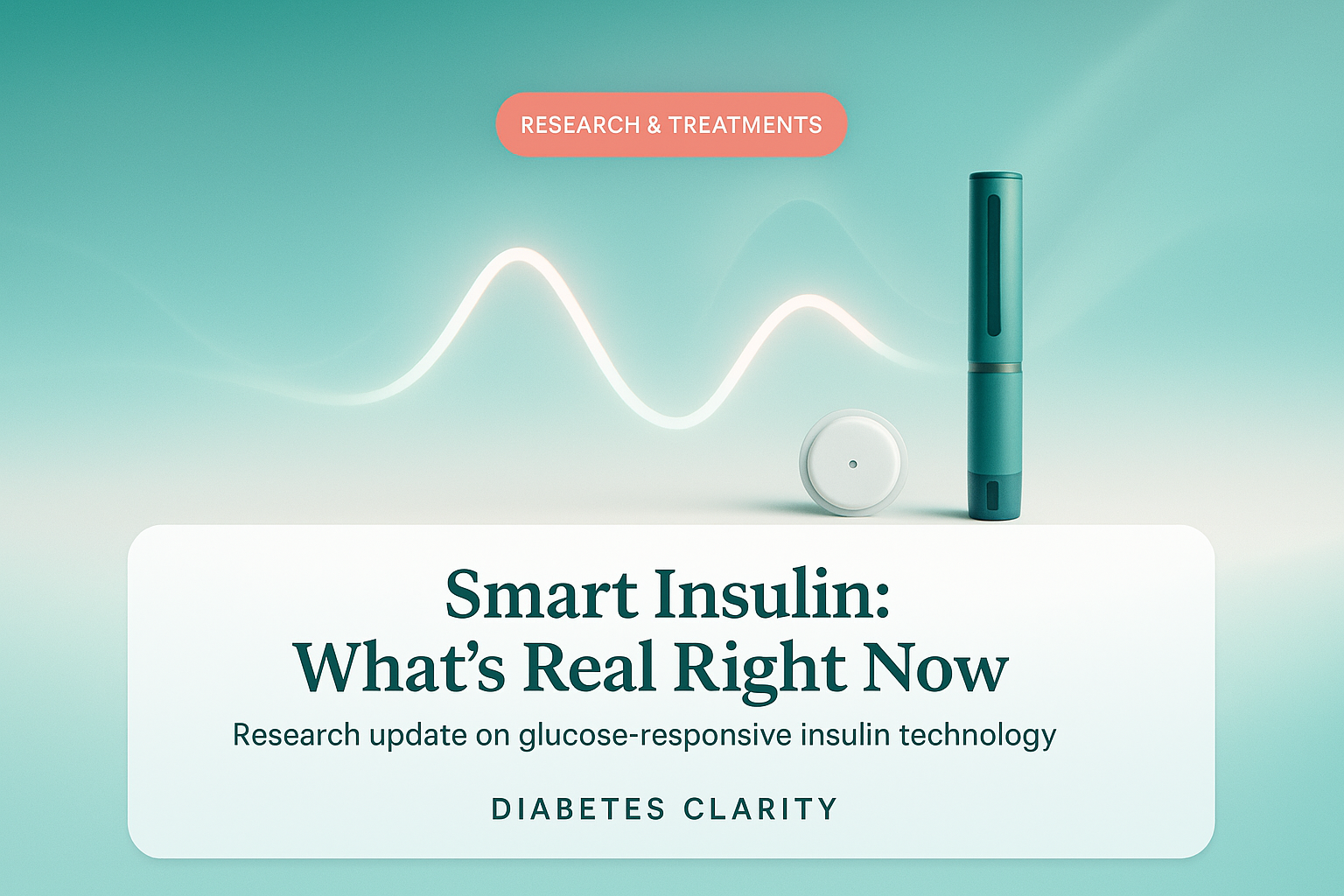
Imagine an insulin that switches itself on when your blood glucose rises and switches off when it falls — no injections, no guesswork, no risk of overcorrecting. This is often called “smart insulin” or glucose-responsive insulin, and it has been a dream of diabetes research for decades. In October 2026, there’s genuine progress to report — but it’s important to understand exactly what has changed, and what hasn’t yet.
The short version
- A true glucose-responsive insulin molecule — one that automatically turns on and off inside your body depending on your blood glucose — is still experimental and not available to anyone yet.
- The real action right now is in smarter automated insulin delivery (AID) systems and connected insulin pens, which combine sensors, software and existing insulins to act more like a glucose-responsive system.
- Early laboratory research is also exploring ways to regenerate insulin-producing cells and build “all-in-one” wearable devices, but these are mouse studies or small feasibility trials, not treatments.
- If you use insulin now, nothing changes today — but it’s worth asking your diabetes team about upcoming device options as they become available in Australia.
What’s actually new this month
At the European Association for the Study of Diabetes (EASD) meeting and Breakthrough T1D’s Clinical and Research Congress — both held in October 2026 — researchers shared several updates relevant to “smart” insulin delivery.
One study looked at the MiniMed Smart MDI system, a connected insulin pen platform that alerts users to missed doses or high glucose readings. In a six-month trial of 143 people with type 1 diabetes, those who responded to alerts more often spent about 8 percentage points more time in their target glucose range and had HbA1c (a measure of average blood glucose over about three months) around 0.6 percentage points lower than people who responded less.
Separately, the US Food and Drug Administration (FDA) cleared a new automated insulin delivery system called Twiist, for adults with insulin-treated type 2 diabetes. In a 13-week trial, average HbA1c fell from 8.1% to 7.4%, and time in target range rose from 57% to 73%. This is an FDA clearance for the US market — it is not yet TGA-approved or listed for use in Australia, so check with Diabetes Australia or the NDSS for local availability updates.
Researchers from PharmaSens and SiBionics also presented early feasibility results for an investigational all-in-one patch that combines glucose sensing, insulin delivery and an automated control algorithm, built around a device called the niia signature. This is still in early testing and is not an approved product.
What the early lab research shows
Further from the clinic, two pieces of research point toward longer-term possibilities:
- Scientists at the Joslin Diabetes Center found that switching off a particular gene in pancreatic duct cells caused some of those cells to take on beta-cell-like features, including producing insulin and responding to glucose. This worked in donor cells and in diabetic mice, but the converted cells weren’t fully equivalent to mature beta cells (the cells in the pancreas that normally make insulin). This is laboratory research only.
- A team in China reported a coin-sized wearable prototype combining a glucose sensor and a tiny insulin pump, aiming toward an “all-in-one” artificial pancreas. It has so far only been tested in mice.
Neither of these is a treatment people can access. They show the direction research is heading, not something to expect soon.
Who this affects
- Type 1 diabetes: Most of the near-term technology progress — smarter pens, better AID algorithms, meal-detection features — is aimed at people with type 1 diabetes who use insulin daily.
- Type 2 diabetes: The Twiist clearance signals growing interest in automated insulin delivery for type 2 diabetes as well, not just type 1.
- Prediabetes and gestational diabetes: None of this month’s news relates directly to these groups, since glucose-responsive insulin research is focused on people already using insulin.
Breakthrough T1D (formerly JDRF) also highlighted ongoing work on a “digital twin” concept and AI-assisted dosing tools, plus a Tidepool Loop feature designed to automatically adjust insulin around unannounced meals, reducing the need to manually enter carbohydrate counts. This remains in trial stages and is being developed with a future FDA submission in mind.
Availability and cost in Australia
As of October 2026, none of the devices named above — MiniMed Smart MDI, Twiist, or the PharmaSens/SiBionics patch — have confirmed TGA approval or PBS listing in Australia. Australia already has several AID systems and continuous glucose monitors (CGMs) available through the NDSS, and new technology typically arrives here after US or European approval, sometimes with a delay of a year or more. If you’re interested in newer devices, your credentialled diabetes educator or endocrinologist is the best source of up-to-date information on what’s locally available and PBS-subsidised.
What we still don’t know
Glucose-responsive insulin that works purely through chemistry — without any external sensor or pump — remains unproven in humans. We don’t yet know how reliably such a molecule would respond to real-world glucose swings, how it would behave during exercise or illness, or how long it would take to reach everyday use if it does succeed. Similarly, the beta-cell regeneration research is very early, and converted cells so far don’t fully match natural beta-cell function.
What this means for you
- Continue using your current insulin and monitoring routine as advised by your healthcare team — none of this research changes today’s treatment.
- If you’re curious about newer pens, pumps or sensors, ask your GP, endocrinologist or diabetes educator what’s realistically available in Australia and whether you’d be a suitable candidate.
- Be wary of any product or supplement claiming to be “smart insulin” available for purchase now — genuine glucose-responsive insulin is not yet on the market anywhere in the world.
- Keep an eye on trusted sources like Diabetes Australia and the NDSS for updates on when new AID systems might become available locally.
Technology that makes insulin dosing safer and less burdensome is genuinely improving, even if a fully self-regulating “smart insulin” molecule is still some years away. For more on managing insulin day-to-day, explore our guides and recipes elsewhere on Diabetes Clarity.
📖 Sources:
• EASD 2026 (European Association for the Study of Diabetes) – MiniMed Smart MDI alert-response trial data – October 2026
• Medtech Dive – FDA clearance of Sequel’s Twiist automated insulin delivery system for type 2 diabetes – October 2026
• Joslin Diabetes Center – ALDH3B2 gene silencing and beta-cell-like conversion research – October 2026
• Breakthrough T1D Clinical & Research Congress – automated insulin delivery algorithms and Tidepool unannounced-meal trial funding – October 2026
• South China Morning Post – Chinese all-in-one mini artificial pancreas prototype (mouse study) – October 2026
• PharmaSens/SiBionics via AdnKronos – niia signature patch feasibility findings presented at EASD 2026 – October 2026